Type the question into Google and you get a dozen calculators, all confidently telling you a different number.
None of them have seen your kitchen, your garage or the cupboard under the stairs, which is where the real answer lives. Two houses with the same number of bedrooms can need wildly different amounts of cardboard.
So rather than hand you another guess, here is how to work out your own number, and how to get the box sizes right so the packing holds up on moving day.
The short version
- Box calculators guess from your bedroom count, which is the part of a house that varies least.
- Heavy things go in small cartons and light bulky things go in large ones, never the reverse.
- Walk the house and count shelves, drawers and cupboards rather than individual objects.
- The kitchen, garage and linen press are where most people underestimate.
- Pack boxes full and square, tape the base properly, and label the side not just the top.
- Get more cartons than you think you need; spares cost little and running out costs a night.
Why box calculators get it wrong
A calculator asks how many bedrooms you have, because that is the only thing it can ask. Bedrooms are the one part of a house that packs down predictably.
Everything that blows a box count out sits somewhere else entirely. The garage, the linen press, the shed, the book collection, the kitchen of someone who actually cooks, and the wardrobe of someone who has never thrown out a jacket.
That is why two neighbours in identical houses can finish a pack a dozen cartons apart. Count what you own, not what your floor plan says you should own.
Get more boxes than you think you need. A spare flat-pack carton costs almost nothing and takes no room, but running out at 9pm the night before moving day costs you the whole evening.
The boxes that actually matter
Most of a move runs on a handful of carton types, and using the right one is what stops a box splitting or a back going.
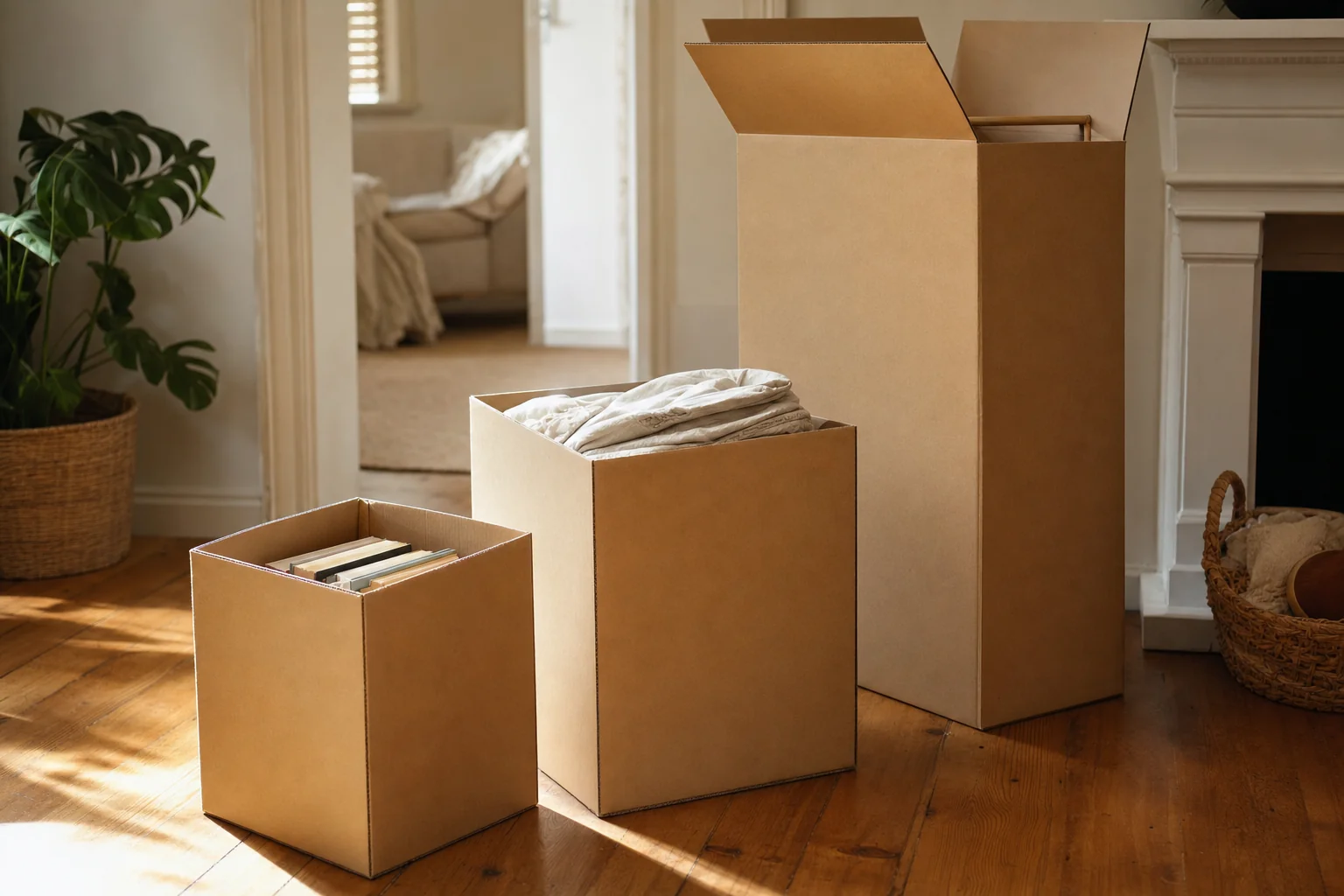
The rule underneath all of it is simple: heavy things go in small boxes, light bulky things go in big ones. Get that backwards and you end up with a book carton nobody can lift and a linen box crushed flat at the bottom of the stack.
- The small carton. Books, tools, tinned food, records and anything dense. Small enough that a full one stays liftable.
- The medium carton. The workhorse for kitchens, pantries, toys, office gear and general odds and ends.
- The large carton. Bedding, pillows, linen, cushions and light bulky things. Never books.
- The wardrobe carton. A tall box with a hanging rail, so your hanging clothes go straight across without being folded or refolded.
- Picture and mirror cartons. Flat cardboard for framed art, mirrors and glass tops that must not sit in a stack.
- Butcher's paper, bubble wrap and a tape gun. Not boxes, but the pack falls apart without them.
Work out your own number, room by room
The honest method takes about twenty minutes and beats any calculator. Walk the house with a notepad and count containers rather than objects.
Look at each shelf, each drawer and each cupboard and ask what it would fill. A shelf of books is a small carton. A drawer of tea towels is part of a large one.
- Kitchen first, because it is almost always the biggest surprise. Count the cupboards, not the plates.
- Bedrooms next. Hanging clothes go to wardrobe cartons, folded clothes and linen to large ones.
- Bookshelves, and be honest about how many shelves there really are.
- Bathrooms and the linen press, which hide more than they look like they do.
- The garage, shed and laundry, which is where most people underestimate by half.
- Add the awkward ones last: pictures, mirrors, lamps and anything glass.

Packing them so they survive the truck
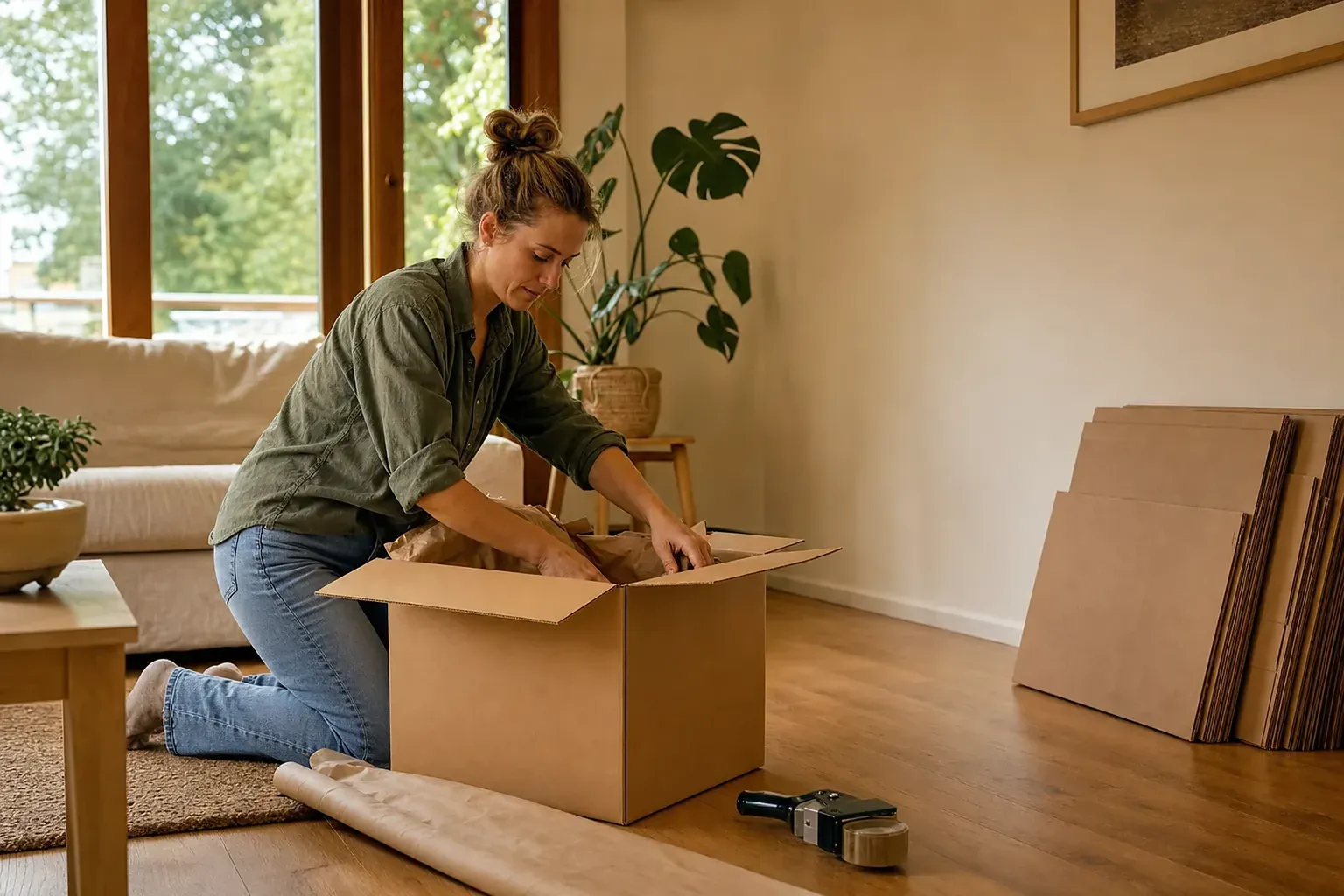
A carton has to hold its shape while other cartons sit on top of it. Half full and loosely packed is how boxes collapse in transit, and a collapsed box is how things break.
Fill every gap so nothing shifts, and close the top flat so the box can be stacked. If it bulges or rattles, it is not finished.
- Tape the base along the seam and across it, not just one strip.
- Wrap plates individually and stand them on edge rather than stacking them flat.
- Fill voids with paper or soft items so nothing moves when you tilt the box.
- Keep each box liftable by one person, whatever the size says.
- Label the side as well as the top, with the room and roughly what is inside.
- Mark the fragile ones clearly so they get loaded last and high.
Label the side, not just the top. Once the boxes are stacked in the truck the tops disappear, and the side label is the only thing anyone can read.
Where the boxes come from
You have three realistic options in Perth, and the right one depends on how much time you have rather than how much you want to spend.
Free supermarket and liquor store cartons are genuinely useful for light odds and ends, but they are mismatched sizes that stack badly and often carry damp or old food residue. Buying new cartons gets you uniform sizes that stack properly, which makes a real difference to how the load rides.
The third option is to not chase boxes at all. Francis brings the cartons, paper, bubble wrap and tape in the right sizes as part of the packing service, so nobody is doing a hardware run the night before.
Frequently Asked Questions
There is no honest single figure, because it depends far more on your kitchen, books and garage than on the bedroom count. Walk through each room counting what would fill a carton, then add a few spares. It takes twenty minutes and is far more accurate than any calculator.
They are fine for light, non-fragile odds and ends. The catch is that mismatched sizes stack badly in a truck, and used food cartons can carry damp or pests. For anything heavy or fragile, proper cartons are worth it.
Yes. If you book the packing service, Francis brings the cartons, butcher's paper, bubble wrap and tape in the sizes the job actually needs, so you are not chasing boxes the night before the move.
The smallest one that fits them. Books, tools and tinned food belong in small cartons so a full box stays liftable and the base does not give out. Large cartons are for bedding, pillows and linen.